Ma'at — Truth
The first weighing begins with what is true.
Aritu are sacred gateways or thresholds of passage. Within Dhyani Love's living framework, each Aritu invites a man to confront, align and embody a principle before moving forward.
Historical Record
Ma'at is one of the central organising ideas of ancient Egyptian thought. The word is used for truth, justice, balance, order and right relationship — the proper ordering of the world, of society and of a single life. Ma'at is also a goddess, most often shown as a seated woman wearing a single ostrich feather, or represented by the feather alone.
Egyptian kings were expected to uphold Ma'at and to present it to the gods; officials described their careers in those terms in tomb autobiographies, and wisdom literature repeatedly frames a good life as a life lived by Ma'at. The idea therefore appears across royal, religious and everyday contexts rather than in one text alone.
The best-known image of Ma'at comes from funerary literature. In Chapter 125 of the Book of the Dead, illustrated famously in the Papyrus of Ani in the British Museum, the heart of the deceased is placed on a balance against the feather of Ma'at while the deceased declares that they have lived in accordance with it. The scene is a statement about the alignment of a whole life, and Egyptologists read it as an affirmation of moral order rather than a scene of terror.
The Seven Scales of Ma'at is not an ancient system. There is no attested seven-stage initiation of this kind. What the historical record gives is the principle and the image; the framework built on that image belongs to Dhyani Love.
Living Reflection
Most men learn early how to manage an impression. You learn which parts of yourself are welcome in a room and which parts to keep behind the door. Over years, the managing becomes automatic, and the distance between the man people describe and the man who lies awake at three in the morning quietly widens.
Truth at this Scale is not confession and it is not exposure. It is the simple, unglamorous act of stopping the negotiation with yourself. Most men already know the thing they are avoiding. They know the habit, the silence, the resentment, the half-finished apology. Truth begins by letting that knowledge stand in the room without immediately explaining it away.
Reputation is what is said about you. Character is what remains when nothing is being said. The two can drift far apart without anyone noticing, and a man can be widely admired while privately out of alignment. Ma'at asks about the second one.
There is also a discipline here about how truth is spoken. Honesty is not permission to be cruel, and accountability is not the same as humiliation — your own or anyone else's. A man who uses truth as a weapon has not reached this Scale; he has only found a sharper mask.
Dhyani's Transmission
Within my living framework, the first Aritu is grounding, because truth needs somewhere solid to stand. A man who begins with visions and ends with nothing changed has skipped this threshold.
A man cannot return to balance while negotiating with what he already knows is untrue.
I do not ask a man to tell me everything. I ask him to stop lying to himself in the small places, because that is where the drift begins. The heart is not weighed against what you meant to do. It is weighed against how you actually lived.
Start where it is uncomfortable and ordinary. One truth, named plainly, without a story wrapped around it to make it bearable. That is the whole of the first Scale.
— Dhyani Love
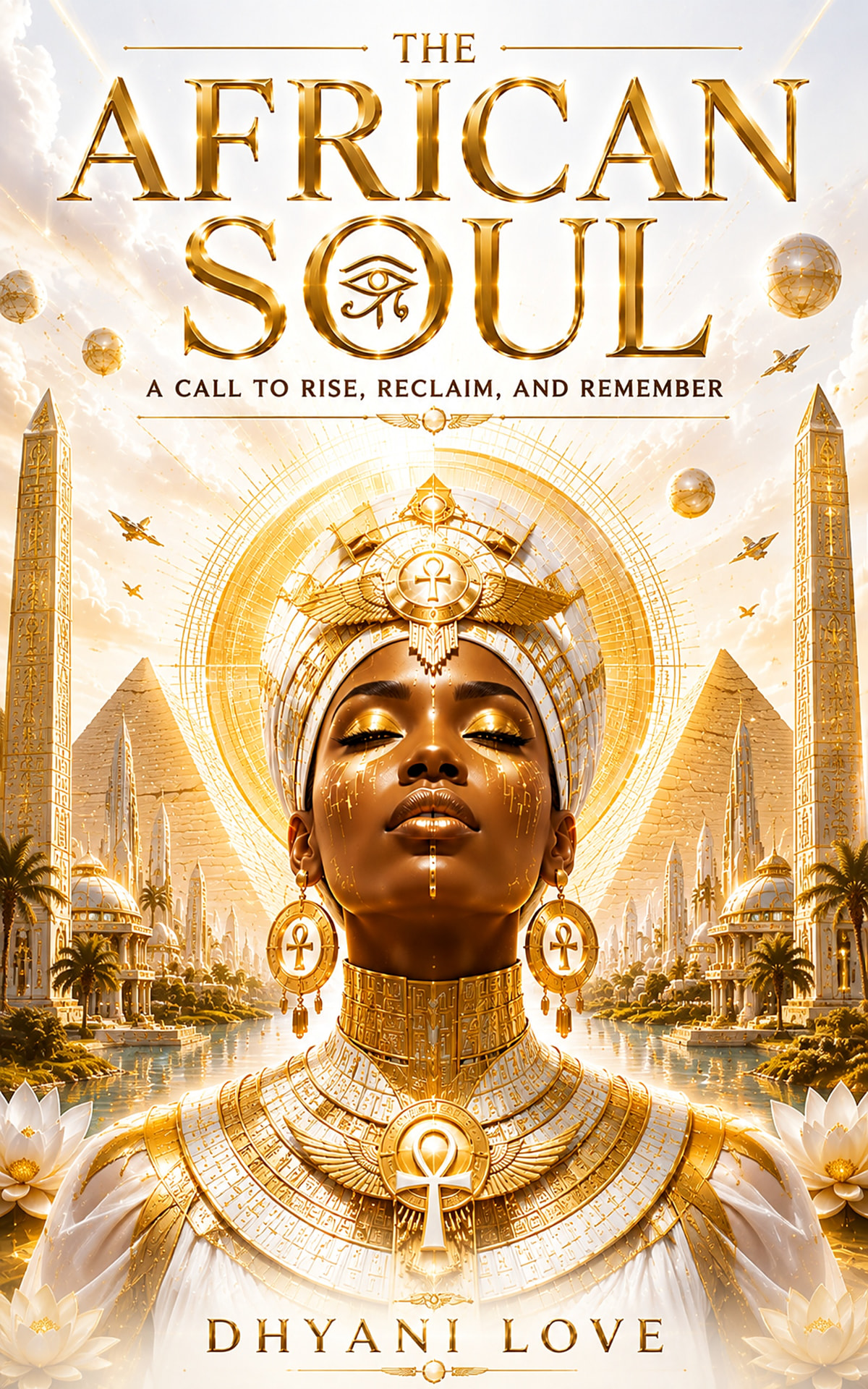
The African Soul: A Call to Rise, Reclaim, and Remember
The book behind the teaching — a call to rise, reclaim and remember.
Get the BookAvailable on Amazon and Kindle Unlimited.
Three Questions for Reflection
- What is the one thing you already know about yourself that you keep explaining away?
- Where is the widest gap between the man people describe and the man you know yourself to be?
- When you last told the truth and it cost you something, what did you learn that comfort would never have taught you?
One Practice
Standing on Solid Ground
Find a patch of earth, grass or stone and stand on it — barefoot if it is safe to do so. Stay there for a few minutes without your phone. Then write down one thing you know to be true and have not yet said even to yourself. Read it aloud, alone. Do not add an explanation, a defence or a plan. Let it be said once, and leave it written where you will see it again this week.
This practice is for quiet, private reflection. If anything here brings up more than you can carry alone, speak with someone you trust or a qualified professional. The library is knowledge, not treatment.
Sources and further reading
- The British Museum collection online — Book of the Dead of Ani (Papyrus of Ani, EA 10470)
- UCLA Encyclopedia of Egyptology — peer-reviewed articles on Egyptian religion, language and funerary belief
- R. O. Faulkner (trans.), The Ancient Egyptian Book of the Dead — Chapter 125
- Jan Assmann, Ma'at: Gerechtigkeit und Unsterblichkeit im Alten Ägypten
- Maulana Karenga, Maat: The Moral Ideal in Ancient Egypt
- Miriam Lichtheim, Ancient Egyptian Literature (wisdom texts and autobiographies)
Dhyani's Transmission is her own teaching and carries no external source. See also her book The African Soul: A Call to Rise, Reclaim, and Remember.
Return to the Seven Scales Library · Explore the Men's Return
Experience The Seven Scales of Ma'at
The library offers the knowledge. The Return offers the lived journey.
Men's Return · 11–18 November 2026 · Heisa Island, Aswan, Kemet (Egypt) · Maximum 10 men
The Seven Gates Knowledge Library offers spiritual education, reflection and personal practices. It does not provide medical diagnosis, psychological treatment, legal advice or guaranteed outcomes. Spiritual support should work alongside—not replace—appropriate professional care. You remain the authority over your choices, body and beliefs.